Showing posts with label fabrication. Show all posts

Sunday, August 11, 2024

08.12.2024 T is for...

The chain - with my Mom's gold hoops
Trombone (links) and t-bars.

I finished my summer classes at ACC the end of July, and the promptly went on vacation (more about that another time) - but in my catch up last month I promised a full post about making the chain, so here it is.

You might recall that when I wrote about this chain, I mentioned I had been eyeing vintage trombone chains (so called because their long, oval links look like trombone slides) for some time.  

They are expensive - and what I really wanted (and had not found) - was one that was primarily silver.

With almost an entire semester in front of me, and experience making a simpler chain in my spring semester class I decided that this was going to be my focus for the summer session. 

Prototyping in copper
Given the cost of the metals (the gold for 15 small links was over $500) my instructor encouraged me to make a prototype in copper before placing any orders.  I did, and that process helped me determine not only how much metal to buy, but also what size wire to use for the links.  

I definitely wanted a substantial chain, but not so heavy that I couldn't wear it comfortably.  I settled on 12 gauge wire for the large oval links, and 14 gauge wire for the small round links (in both silver and gold).


Having determined how long I wanted my chain and how much wire I would need, I placed my order and got to work.

Side note: wire gauges are standardized based on the amount of electrical current they can carry - and they date back to the 19th century.  Both gold and silver wire CAN conduct current, but because of their relative value, they are not generally used.  Most modern electrical wiring is copper, but all wiring - whether or not it is used for jewelry - follows the same gauge measurements.

Six feet of wire, reduced to links
It takes a lot of wire to make chain.  

I ordered a little over six feet of wire (five feet of silver and just over a foot of gold) in order to make a 20 inch necklace.  I formed the oval rings using pliers, and the circular ones on a jump ring maker (yay for all the toys in the ACC Jewelry Department).

Each circular ring used about an inch of wire, and the oval rings took just over two inches.

Once the links were formed and shaped, they needed to be soldered.

In the tumbler to polish
The silver ovals and gold circles were all soldered closed, and then I connected the links - one at a time - by soldering the silver circles between the oval and gold links.  Getting all the links connected was an accomplishment, but I was by no means close to finished.

There was a lot of clean up to do - extra solder had to be sanded off each joint (there are a total of 60 solder joints in the chain).  Sanding was followed by additional pre-polishing and finally, after the chain was assembled - including the clasps - it went into the tumbler.

The second part of the project was making a t-bar.  I styled my chain after vintage watch chains - with swivel clasps on each end - which often had t-bars to hold the pocket watch chain in a buttonhole.


T-bar components - unassembled

My classmates were making a toggle clasp for a bracelet -  I modified the assignment to make a larger toggle to hang pendant style from my chain.  

Throughout the semester, our instructor had been saying that all the skills we were building would be required - and tested - in the making of the toggle.  She was not wrong.  

Even with a substantial amount of soldering experience, making the t-bar was a challenge!

Fabricating the t-bar required fitting small jump rings on the center of the bar, and soldering all the pieces together to create a long barbell with a center bail.

The chain and t-bar
With a little help - and quite of bit of patience - I completed the t-bar as well as the chain and I'm really enjoying wearing it.  

I'll be going back to class in a few weeks, and for the first time since I started taking classes (almost 10 years ago) the goal won't be to actually make anything.  Instead, I'm going to be taking stone setting which involves learned to take pre-cast settings and modify them to accommodate faceted stones.

After two semesters of fabrication review I'm ready to focus on learning something completely new.


I'll still have access to the benches and all the wonderful tools at ACC, so I imagine I will continue to make things for myself (and maybe others) - but I won't be adding to my jewelry collection in quite the same way.  I will, however, continue to post and write about what I'm learning.

Between now and a stone setting post, I'll be sharing our recent vacation in Santa Fe.

Until next time.


Monday, March 11, 2024

03.14.2024 March Madness

My basket set pendants

Those of you who follow my Instagram account might remember that on Monday I put up this cute photo of my pendants, with the message that internet goblins ate the blog post I had all ready to go for March, 

My CR-V post impact


and THEN later that day I posted THIS photo of my car, after getting hit on the way home from running errands and stated there would be no blog post this month.


Today, after hours on the phone dealing with insurance, I changed my mind and decided I needed to write.

Originally, I had titled the post "A tisket, A tasket" because I was writing about making basket settings, and couldn't figure out how to tie that to basketBALL. I had considered "Slam Dunk" or "Nothing But Net" but those didn't work at all

Then Monday happened, and I decided that this week has, in fact, been madness...so that's the title I'm going to use...and now I will attempt to reconstruct my story about making basket settings for pendants.

I put a fair number of progress pictures up on my IG account, but I thought you might find a narration of the process interesting...so here goes.

An early - and still favorite
bezel set turquoise
I have set a lot of stones along my jewelry making journey, but they have all been bezel set - which means a piece of sheet metal was fitted tightly around a cabochon (flat backed stone) and soldered (or fused) to a backplate (another piece of sheet metal) to create the setting for the pendant.  

Bezel and basket settings use the same materials - sheet metal and wire (they can also be carved in wax and cast in metal) - to create the framework for the pendant, but that's pretty much where the similarity ends.


Beginnings of the basket
As with bezel setting, geometry and order of operations are critical for creating basket settings - maybe even more so.

For a basket setting you do shape the metal to match the shape of the stone - but these stones are faceted on the back - so instead of fitting inside the metal, the stone sits on top of the setting.

Instead of adding pieces to make the setting - as you do with a bezel pendant - you cut metal away to open up the basket.

I started with the turquoise because it's much easier to build a setting - any setting - for a round or oval stone than for one with corners like the tourmaline.

First set of prongs


After forming the sheet metal, and making sure the stone sits properly on top of it, you begin to cut away the center portion of the metal - leaving two thin bands.  

It's important that you only cut halfway around the setting at first, otherwise you will have two completely separate wire-thin pieces and completely eliminated the advantage of fabricating the basket from sheet.


Once the basket is half open, you attach the first set of prongs - which gives your piece stability while you open the other side - and then attach the other set of prongs.

Oops
The process is essentially the same for a square or rectangular stone, but there are corners - and those are tricky.  The base has to have 90 degree angles; to achieve those you create mitered corners by filing into the sheet metal before you bend it, and then you solder the corners to reinforce the metal.

If you file too deep - or get your metal too hot - your box will fall apart and you get to make it again...all part of the learning process.

Using 3rd arms to hold the piece in place

The second attempt at the rectangular setting went better, and faster, than the first...and turned out quite well.  Same process once I had the base constructed - cut out one side, solder carefully, cut out the other side, and finally attach a bail.

When making a pendant, you do need to leave a small piece of solid metal at the top of the basket so you have a place to anchor the bail.


A word about adding the bail.  That went much better on the second pendant as well - and had nothing to do with the shape of the basket.

Ready to polish and set

For the turquoise pendant, I got everything set up and attached the bail using pick soldering (picking up the solder with a special tool and placing it where it will flow and attach pieces together).  That works great, except when it doesn't, and because my solder didn't flow on the back side of the bail, I ended up melting it off and doing it twice.

For the tourmaline, I opted to sweat (melting the solder on to the frame before placing the bail down) solder the pieces together - learning from my mistake - and it went beautifully.

None of these setbacks were particularly frustrating or problematic - they were simply opportunities to learn - which is why I signed up for classes in the first place.  I went back to the bench with a desire not so much to make more of what I had done before, but to challenge myself to make new and different things.

Cookie - keeping me company
ACC is on spring break this week - but I'm excited to go back and fabricate another basket setting, or two, before the end of the semester. One of the truly wonderful things about being a continuing education student is that I can sign up for the same class more than once - so it's my intention to take Jewelry Technique 1 again, and continue to learn from master goldsmith Steve Kriechbaum.

Watch this space - there's definitely more to come!

Until next time.


Monday, February 19, 2024

02.19.2024 Chain, Chain, Chain...

The second class project in my ACC jewelry techniques class involved making jump rings and connecting them together to create a chain.

Jump rings - for the non-jewelry types - are the open rings used to connect components of a piece together.  They are used to make loops for hooks on earrings, as simple bails for hanging a pendant or to attach a clasp to the end of the chain.

Jump rings - off the mandrel - before being sawed apart

I decided I wanted to fabricate a necklace with graduated links.  I sketched my idea in my notebook, then calculated the size - and how many of each - jump rings I would need.

The inspiration for this necklace came from several other pieces - a beautiful string of graduated pearls my Father brought home to me for my 21st birthday, from a trip to Japan; the Pat Areias silver statement chain I bought last summer in Carmel, and a round push lock charm holder from Cari Streeter, one of my favorite jewelers.


I settled on the design, with the push lock in the front, and small double rings to connect the links. Then I made jump rings...a lot of jump rings.

You can buy preformed jump rings (open - with a cut in the ring, or closed) - but where would be the fun (or learning) in that?  

The facilities at ACC are amazing - and they have all the toys - including a jump ring maker.  You wrap a piece of wire around a mandrel, and put the mandrel in a vice with a crank, turn the handle and voila - a stack of jump rings (that look like a spring).  

Laying out the necklace before fusing the rings
Once you have a coil of rings, the next step is to saw through them one at a time, then finish them by aligning the cut edges and making sure they are truly round.

I made the larger ones (30 for the necklace, plus a few extras) and ordered more small, closed ones from Rio Grande, in order to connect them all together. I'll admit to being more than a little pleased that I didn't melt any!

As I started assembling the necklace, I realized that although it would have the push lock in the front, it really wanted a clasp in the back to make it easier to take on and off, especially since I had decided to add some of Cari's wonderful briolette charms to the clasp.

Push lock clasp and briolettes from Cari
Rather than trying to make more rings and create a clasp in back, I ordered a short (16 inch) rolo chain, and used it to finish the necklace.  A case of working smarter not harder, especially because it only took about 4 inches of chain, and it doesn't show on the front. 

I simple cut the chain, preserving the clasp, and soldered it to the end of the necklace.

I'm so pleased with the finished piece!


It's always great when something turns out as planned


It's always wonderful when a design turns out exactly as I envisioned it (and that doesn't always happen - when I first started metalsmithing classes my visions waaaay exceeded my ability - and I have been away from the bench for quite a while).

I'm also delighted to have jewelry projects to write about again - so watch this space, class continues until May - and I'm planning on signing up for another semester in the fall!

Up next - new techniques for stone setting - starting with this fabulous faceted turquoise (then the tourmaline and opal).


I hope you are enjoying following as much as I am writing about my projects.

Until next time.


P.S. A few of you asked if I'm going to be making things for my Etsy shop, and the short answer - at least for a while - is no.  I had three great markets at the end of 2019, and then as we all know - things changed - and one of the most important things that changed for me was the realization that I've had a career, I built a business, and I don't need to do it again.  Maybe after a semester or two, I'll change my mind - but right now the best part of making jewelry is learning, and being free to do it simply for my own enjoyment.

Monday, March 11, 2019

03.11.19 The third time's the charm

Photo credit: Creative Side
This little black onyx cabochon was one of the first stones I ever bought - and it's finally found its happy place.

The first time I used it was in my Fabrication 201 class, because it seemed to be a perfect compliment  to the teardrop shaped hollow form earrings I made.


I love the earrings - and I wear them a lot - but the hinge on the original pendant didn't work, and I just wasn't happy with it.

So, I popped the stone out, recycled the silver and put it into a different necklace.  The second time, I paired it with a larger piece of petrified palm in the first two stone necklace I made. 


I was definitely getting there, because that time I put a hamsa on the back of the pendant - which I have retained in the third iteration of the piece.

While the concept was good - after a while, I realized I still wasn't happy (I've made other two stone necklaces that I like much better). 


Aesthetically, the look fell flat, and it didn't hang particularly well when it was worn.  This is the benefit of practice - your work continues to improve, and working with sustainable, recyclable materials means you can remake a piece.

So recently, I popped it out of the setting - again - and I set it a third time. 

This was the charm!  

My work is better, and the stone is complemented by the patina on the setting (it just didn't pop in the plain setting). I kept the hamsa, this time with addition of an evil eye.


I'm calling it "These Dark Times". The world we live in is turbulent and unsettling, and I wanted something that felt like an amulet...and it looks great with the earrings.

This isn't the first time I've remade a piece - and it won't be the last - and that doesn't bother me.  My goals with metalsmithing have always been to make things I want to wear - and to keep learning.  

Until next time.


Monday, April 3, 2017

04.03.17 Hot Stuff!


We had a great time raising money for Hill Country Ride for Aids and hanging out at the Salado Glassworks a couple of weekends ago.  Watching glass artist extraordinaire and gallery owner Gail Allard and his colleagues heat, shape and blow glass for hours was a blast.


When you walk into the gallery you are met with an explosion of color...there is glass on the walls, hanging from the ceiling, on the shelves - in all sizes and shapes - and all created by Gail and his fellow artisans.


From the gallery you can walk through to the huge studio where, on this particular Saturday afternoon, Gail and three others, were all working together to make amazing creations.


The studio is huge - with bleacher seating so that you can sit and watch (for hours...) as glass artists work their magic.  The process starts with a small amount of clear molten glass (about 2400 degrees and it has the consistency of honey) - called a "gather" - collected on the end of a long pole.


The hot glass is then rolled and dipped into chips of colored glass, heated in a furnace and shaped - often multiple times - before the blowing a small amount of air into the pole and trapping it - causing a bubble to form and expand the size of the glass.

It was amazing to watch one of the guys blow just a puff into the tube, cover the opening and see the glass expand as the air inside got hot.

It's definitely a team effort - and takes at least two people to make a single large piece.  After the air bubble is created, there is a transfer to another pole (made me nervous just to watch) and then the open end is heated, shaped, and you can see the piece evolve until it is finished.


Gail spinning a huge bowl open
Photo credit: Salado Glassworks.
The finished pieces are separated from their poles (another impressive and highly skilled task that appears to involve just a few taps - but watching you know better) and placed in an annealing cabinet to cool.

When I first learned that in glass making the term annealing refers to the slow cooling that takes place to ensure that the piece doesn't crack when subjected to future changes in temperature (such as mug that hold hot coffee or cold beer).


When I first heard someone talk about annealing glass (last summer at the Corning Museum) I was a little confused - because while glass annealing involves cooling, in jewelry making (or most other types of metal work) annealing involves heating the metal to make it more workable.

Photo credit: Creative Side 
As metal is worked, it becomes harder - so you anneal a piece as you go in order to make it softer and ensure it doesn't break as you bend or shape it - because metal, especially argentium silver (my metal of choice) can crack if you stress it when it is too hard.

Back to the glass...I spent a lot of the day watching, and learning - and the staff was so gracious with their time and information - they even sent me home with a couple of trinkets and some glass to play around with.

Until next time (which will be in two weeks - the kiddo is coming home for break - so the blog will be back on April 17)..


Monday, March 13, 2017

03.13.17 Keep Calm and Solder On

Sticker from Rio Grande
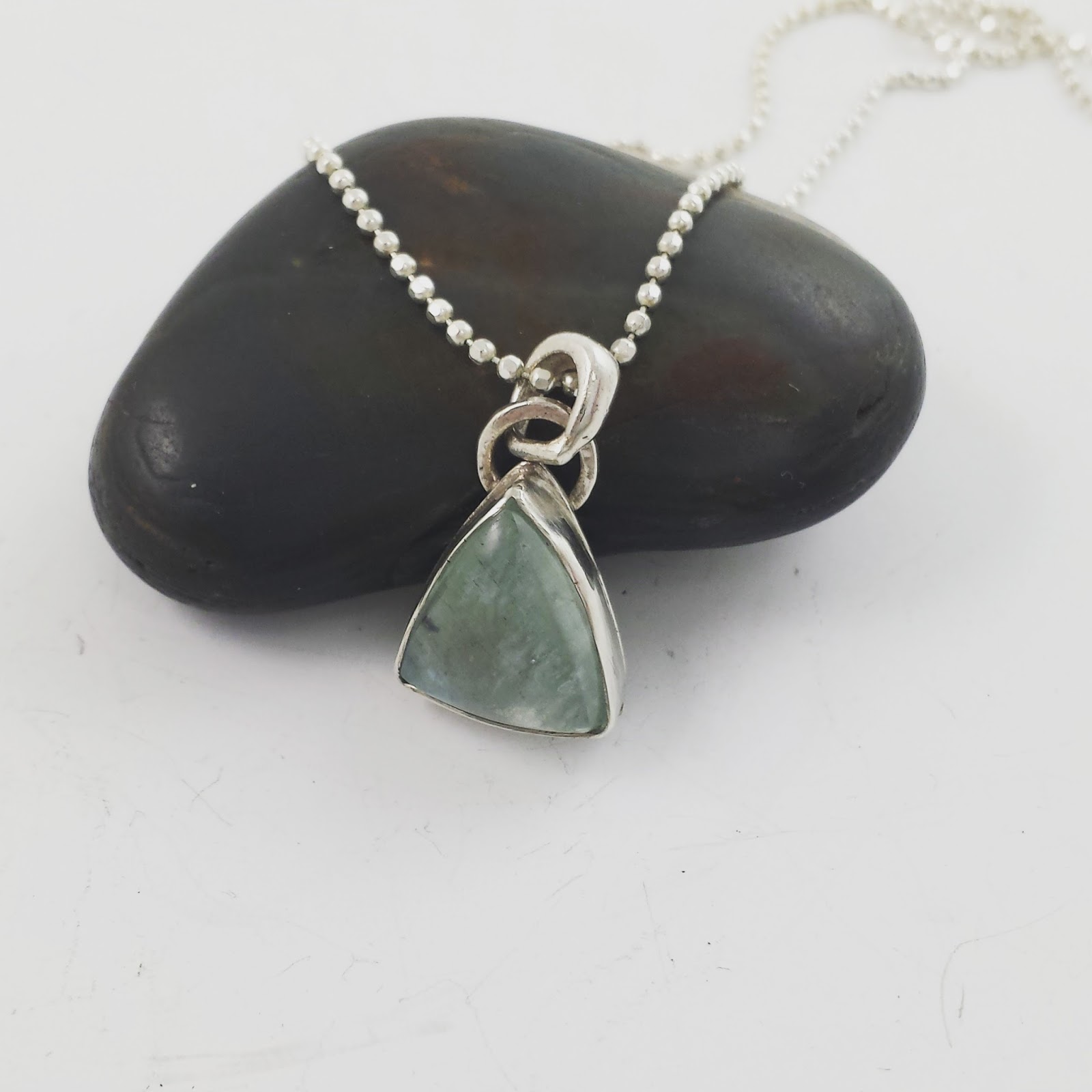
When I took my second fabrication class, whatever I lacked in skill, I made up for in ambition.  The class was in March, and my husband has a March birthday (this year it ends with a zero!) - so I thought, I'll make a piece with a March birthstone - aquamarine - in his honor.


I sketched a design and bought a stone (a triangular cabochon, because setting a stone with corners was our first assignment), but there were some things I didn't account for...


...including that we were going to do this practice piece in a single evening, and that the smaller the stone, the trickier it is to set.


So there were things in the original sketch that didn't make it into the finished piece..and it's the only pendant I've made that didn't have a cut out on the back plate.  There was a little heart in the sketch - but not only was there no time to do that, I really didn't have sawing skills to do something that small quickly (yet).


It turned out okay, but I was feeling emboldened after resetting my thunderstorm labradorite, and decided I'd pop the stone out and make another new setting.  


This time, I did put a small heart cut out on the back and used serrated wire instead of a plain bezel.  I really like the look that the fancier bezel (also called gallery wire) gives the finished pieces.

The reworked piece makes me happy for so many reasons - for starters - my work is just cleaner than it was a year ago.


The corners are sharper,  the jump ring and bail are more appropriately sized to the pendant, and the opening on the back lets in light, which shows off the stone.

Both of my instructors for 201 happened to be in the studio when I was resetting this stone.  They smiled, said "good job" and encouraged me to keep making mistakes - and fixing them - because that's the best way to learn.

No project is ever going to be perfect, but every day in the studio gets me a little closer.
Until next time.


Monday, September 26, 2016

09.26.16 Single Ladies

...if you wanted it you shoulda put a ring on it...oh, oh, oh...

...as I started writing this post, I began to hear Single Ladies playing in my head...

There was a time when, if my daughter wanted to annoy me a little bit while we were spending some quality time in the car, she would begin to sing the chorus of Single Ladies (if she wanted to annoy me A LOT she would begin to hum Nutcracker music).  I do miss my daughter, but honestly, I don't miss all those hours driving the mom bus afterschool, evenings and weekends (now I spend that time at the jewelry studio).

Over the past several months of buying larger stones for my pendants, I have accumulated quite a nice collection of "littles" that the lapidary artists have included as extras with my purchases.  As I spread them out and looked at them recently, I thought "I should put a ring on that" (ok, what I really thought was "I should put that on a ring..."). The thing is - I hadn't made a ring since I took Fabrication 101, and I'd never put a bezel on a ring shank.


I had some wire odds and ends - small pieces of bezel and a length of 12 gauge round - so I started playing around with them and decided to take a day or two off from pendants, and try my hand at rings (pun intended).

Despite all the hours I've spent at the bench over the past few months, I actually approached this simple project with a little bit of trepidation.  The only rings I wear are my wedding and anniversary bands, so I hadn't had much interest in - or given much thought to - making any other ones.

I was pleasantly surprised at just how quickly and easily I could create some simple stacking rings.  There are some things that require special attention - like making sure not to melt the much smaller bezels, and lining up the ring shank with the backplate to make sure the stone sits in the right place.

Over the course of the afternoon, I worked up the beginnings of a nice little collection - and was limited only by the length of wire I had to make the bands.  I got three nice pieces assembled and I've ordered more wire to go with the rest of the small stones.

Not only do the rings go together relatively quickly - especially compared to the large pendants with the cut outs on the back - they require a lot less silver.  The pendants are large, complex and expensive, and it will be really nice to be have some pieces in my Etsy shop at a price below $50.

So - if you like what you see, hop on over to the shop - and put a ring on it.


Until next time.

Monday, June 27, 2016

06.27.16 Out and About

At the end of last year, I said I hoped that 2016 would be the year that I sold my first piece of jewelry - and I am pleased to report that I've actually sold more than one!  It's one thing to wear my own work, or even to have my daughter or sister in law wearing it...but the idea that other people want me to make jewelry for them is really a dream come true!

Chem Lab 2.0

I wasn't at all surprised when my daughter - who inspired my very first tab set pendant, dubbed the "chem lab" - said she wanted one of her own.  So, I made a second one - and learned (although I should have realized) - that you can never replicate a handmade piece exactly!  She's very pleased with it - and likes telling folks her mom made it for her.  I've now made versions 3.0 and 4.0 - it is far and away my most popular design (to date)!

Lapis and Sterling


Not too long after I finished my Fabrication 101 class and started working in open studio, I was out with one of my dearest friends, wearing my first non-class project, this Lapis pendant. She admired it and asked, could I make one for her.  I said of course, and set about finding a blue stone for my very first commissioned piece!

It didn't take too long to find a lovely sodalite. Because I had continued to work every week in open studio, my skills had  improved, so her piece is a little more refined than my original.  Done in argentium rather than sterling, with a smaller backplate and more embellished bail.

Sodalite and Argentium
Around the same time I was finishing the sodalite piece, I was contacted on Facebook by a friend who had been following the blog - and she said she wanted to buy my amethyst pendant as a birthday present to herself!  I was delighted - and realized that my jewelry was really going to be out there - being seen by people outside my circle of family and friends.
Amethyst and Sterling


Since then I have delivered three commissioned pieces - and have more in the queue!

Labradorite and Argentium.


For this beautiful labradorite, I sat down with the buyer and talked about what she wanted.  I had a selection of stones, and she chose one, then I drew sketches for her.  After a discussion about bezel styles and embellishments, she decided that sometimes less is more, and the result is this simple pendant.


Sterling and Citrine hollow form
Most recently I completed and delivered this pair of earrings.  After seeing photos of the hollow form earrings I made in my Fabrication 201 class - a friend asked if I could make them with a different colored stone.  We discussed what she wanted - she chose yellow citrine - so that's what I did.  It was fun to revisit the skills I learned in that class - I made these earrings in sterling, but my plan is to move to argentium, so my next pair will be a somewhat new experience.

I'm so excited - and humbled - that people have asked me to make jewelry for them, or someone important to them. I look forward to putting more of my work, and myself, out there one piece at a time.

Until next time.

Monday, May 30, 2016

05.30.16 The Magic of Argentium - Granulation

Of the four pairs of earrings I made in Ronda's class - these were probably my favorite to fabricate...I loved cutting up the scraps of silver wire, heating them until they glowed and watching them become granules (perfect little silver spheres).

After fusing the wire rings down at the end of the previous day, we began adding embellishments - granules and a bezel for the onyx - to each earring.  This represented a second fusing.  That's something you can do with argentium (but not with sterling) - go back and fuse new components or make repairs to a piece - so long as it hasn't been soldered, or your stone hasn't been set.

Once the granules and bezels were in place, the next steps were to cut away the extra silver and set the stones.

In addition to showing us how to set the stones in a thick bezel (Ronda uses sheet to form her bezels, rather than preformed bezel wire) she also showed us how to make a tempered steel bezel setting tool.  We took a small piece of square steel rod and machined it until it had a slightly tapered end.  Then we filed it and used our torches to temper it.  So - not only did I go home with jewelry - but I also have a bezel setting punch to boot!

Although I have done bezel setting before, I was excited to learn a new technique from Ronda.  She uses the punch and a hammer to set the stone and then flatten the top of the bezel to give it a wider look.

Before setting my stones, I added a patina to my earrings - I really like the way argentium takes the patina, and brightens up to an almost white silver when you polish some of it off.

At the end of the day, after making earwires for both my slumped and granulated earrings - I was three for three, and feeling pretty darned accomplished!


Until next time.